Buying guide
Best UST ALR Projector Screen: What to Look For
The “best” UST ALR screen depends on your room and form-factor priorities. A permanent fixed frame, motorized floor-rising screen and Fresnel panel solve different problems even when all are sold for ultra-short-throw projectors. This guide helps you choose by optical geometry, size, ambient light and installation rather than by a single headline specification.
Independent-guide note: Product-specific facts on this page come from published merchant information reviewed in September 2026. ScreenSignal did not independently lab-test this screen. Prices, availability and policies can change.
Start with projector geometry
UST projectors fire light upward at a steep angle from very close to the screen. A UST-specific ALR surface is designed around that geometry. Do not assume an ALR screen made for a long-throw projector is interchangeable; its optical behavior may send the projector’s light away from the audience instead of toward it.Fixed frame vs floor rising
A fixed frame is usually the simplest route to a consistently flat surface and is ideal when the screen can remain on the wall. A motorized floor-rising screen is better when you need the display to disappear when not in use, but it adds a motor, housing and tensioning system. NothingProjector’s 132-inch seamless model is fixed-frame; Vividstorm’s S Pro line is an example of a motorized floor-rising UST ALR approach.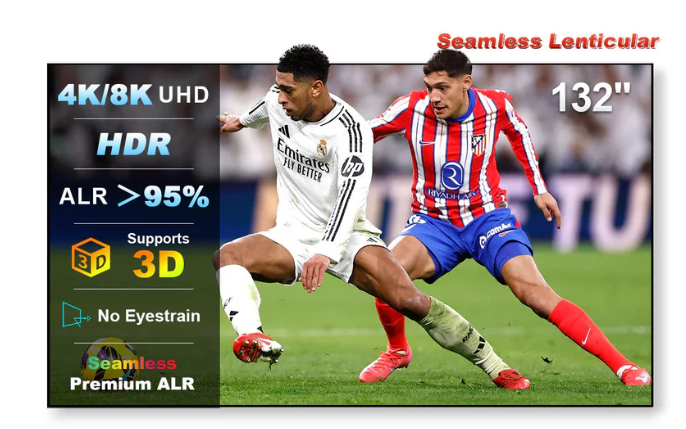
See the 132-inch NothingProjector screen
Check the current price, availability and merchant terms before you buy.
View Current OfferLenticular vs Fresnel
Lenticular material is commonly used for UST ALR screens because microscopic horizontal structures can help accept light from below while limiting overhead light. Fresnel surfaces use concentric optical structures and can offer strong ambient-light control, but viewing-angle behavior and size availability differ by design. The right choice depends on your seating width, light sources and screen-size target.Gain is not a brightness score
Screen gain describes directional reflectivity relative to a reference surface. A 0.6-gain UST ALR screen is not “40% worse” than a 1.0-gain matte screen; the materials are doing different optical jobs. Evaluate gain together with projector lumens, screen size, seating position and room light.Why ScreenSignal features the 132-inch NothingProjector
For a buyer specifically seeking a permanent 132-inch UST setup, the product has an unusually clear value proposition: seamless construction at a size above the standard 120-inch class, 0.6 gain, 170° listed viewing angle and 95% ALR merchant claim. It is not the right choice when you need retractability or a non-UST projector.Buying checklist
- Confirm the projector is ultra-short throw.
- Measure the full wall and furniture footprint.
- Identify ceiling lights, windows and lamps around the screen.
- Decide whether the screen can stay permanently installed.
- Match screen size to projector brightness and seating distance.
- Check return, shipping and warranty terms before ordering.
Ready to check the current offer?
Open the merchant product page through our affiliate link to confirm today’s price, stock and terms.
View Current Offer